How to Choose a Small DC Gear Motor for Your Equipment
How to Choose a Small DC Gear Motor for Your Equipment
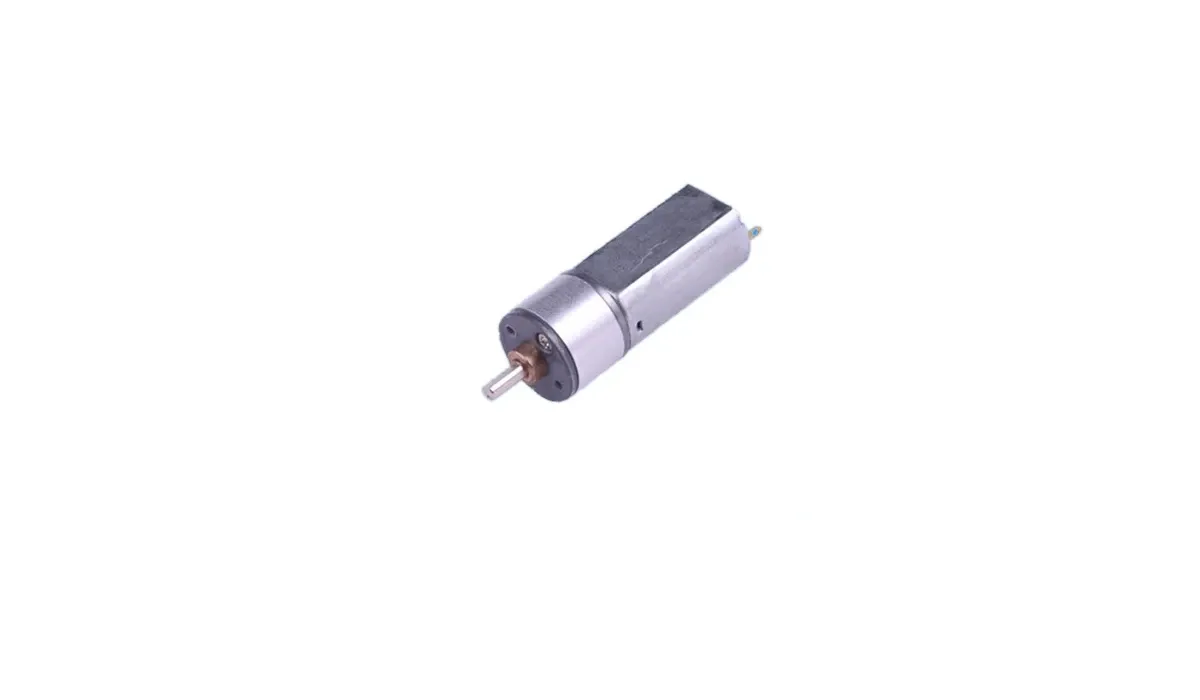
If you are building a machine and need a small DC gear motor, start from the job, not the catalogue. Tell us what the motor has to move, how fast it has to move it, what voltage your machine already supplies, and how much space you have — and we can match a configuration to it, or build one to your drawing. This guide explains the five things that decide the choice, using our 16 mm reference model, the FY-16GA050, as a worked example.
This guide is for buyers choosing a small DC gear motor for a machine or product. If you need a finished irrigation valve (not the motor inside it), tell us your valve type — we build the drive unit to your drawing.
Start with the job, not the motor
A gear motor is a small DC motor with a gearbox that trades speed for torque. The same motor can be fast and weak or slow and strong, depending on the gear ratio — so the right question is never “which motor is best” but “what does my machine need it to do”.
Before you look at any specification, write down:
- What it moves — a valve, a shutter, a pump, a feed screw, a printer mechanism. The load decides the torque.
- How fast — how many turns per minute the output shaft needs. A valve that opens slowly needs far less speed than a pump.
- How it is powered — the voltage your machine already has (for example 6 V, 12 V or 24 V). Matching your existing supply avoids adding a converter.
- How much room there is — the diameter, length and mounting space available. A motor that does not fit is useless, however good its numbers are.
- How many you need — quantity and how often you will reorder. This decides whether a custom configuration is worth setting up.
If you can answer those five points, you already have a specification. If you cannot answer one of them yet, send us what you have — the application and the target torque and speed are enough for us to propose a configuration.
What five numbers decide the choice?
- Voltage — Your machine’s supply voltage comes first. Our reference model, the FY-16GA050, is built for 6/12/24 VDC, so it can be configured to the supply most small equipment already uses. Changing the voltage changes the speed: the same motor runs faster on a higher voltage, and draws more current. Pick the voltage your equipment already provides, then choose the speed and torque around it.
- Speed — Speed is set mainly by the gear ratio. A low ratio gives a fast output; a high ratio gives a slow, strong one. The FY-16GA050 is available with reduction ratios of 148 / 182 / 210 / 256 / 362, so the same 16 mm motor can cover a wide range of speeds. Always state the speed your machine needs at the load, not the no-load speed — a motor always runs slower under load than it does spinning freely.
- Torque — Torque is what the motor can actually move. Check two values: the torque at maximum efficiency (where the motor runs best) and the stall torque (the most it can hold before it stops). On the FY-16GA050 these two values are far apart — for example, one configuration delivers 196 mN·m at maximum efficiency and holds up to 950 mN·m at stall — so do not size a motor on stall torque alone. Size it on the torque your load needs in normal running, with some margin, and check the stall figure only as a safety limit.
- Size and mounting — Small equipment leaves no room for error. The FY-16GA050 is 15.5 mm in body diameter with a 16 mm end face, a 26.9 mm motor section and a 9.5 mm gearbox section, a Ø3 mm round output shaft, and 2-M2 mounting holes in the end face. It weighs about 30 g. When you enquire, send the space the motor must fit into and how it will be fixed — a drawing is best, but the diameter, length, shaft size and mounting holes are enough to start.
- Quantity — Tell us how many you need and how often. Our custom orders start from 50 pcs when materials are in stock, so even a first production run does not have to be large. Quantity also affects sampling: selected models can be sampled free of charge, and samples can be ready in as fast as 1 day, depending on complexity.
Worked example: one motor, two very different jobs
The FY-16GA050 shows how much the gear ratio changes a motor. Both configurations below are the same 16 mm motor family — only the ratio and the test voltage differ.
| Configuration | Voltage | No-load speed | Torque at max. efficiency | Stall torque |
|---|---|---|---|---|
| FY-16GA050-45 | 8 V | 180 r/min | 24.5 mN·m | 122.5 mN·m |
| FY-16GA050-362 | 5 V | 31.5 r/min | 196 mN·m | 950 mN·m |
The -45 configuration is fast and light: 180 r/min, suited to a small mechanism that needs speed and only a light load. The -362 configuration is slow and strong: 31.5 r/min with roughly eight times the torque at maximum efficiency, suited to a load that must be moved steadily against resistance. Same motor size, same 30 g weight — the difference is the gearbox.
This is why we show reference models instead of a fixed catalogue. The voltage, ratio, torque, speed, output shaft and mounting dimensions of the FY-16GA050 can all be adjusted to your drawing. If neither configuration above fits your machine, the right answer is usually a different ratio on the same motor — not a different motor.
Common mistakes when choosing a small gear motor
- Sizing on stall torque instead of rated torque. Stall torque is the most the motor can hold before it stops — not what it delivers in normal running. On the FY-16GA050, one configuration holds up to 950 mN·m at stall but delivers 196 mN·m at maximum efficiency. Size the motor on the torque your load needs in normal running, with some margin, and treat the stall figure only as a safety limit.
- Assuming one model means one speed. The same motor can be fast and light or slow and strong, depending on the gear ratio and the voltage. The FY-16GA050-45 runs at 180 r/min on 8 V; the FY-16GA050-362 runs at 31.5 r/min on 5 V — same 16 mm motor family, roughly eight times the torque at maximum efficiency. Always check which configuration a quoted speed and torque belong to.
- Trusting a datasheet without checking it. Even factory datasheets have typos — we check every sheet before we quote. On the FY-16GA050 sheet, for example, one curve title disagrees with its own parameter table on the test voltage. If a number on a datasheet looks wrong, ask the supplier to confirm it before you design around it.
What to send with your inquiry
Send us as much of this list as you have. A drawing is best, but it is not required to start.
- Application — what the motor moves, and in what machine
- Voltage — the supply your equipment provides
- Torque and speed — what the load needs in normal running
- Size and mounting — diameter, length, shaft, fixing holes
- Quantity — how many, and how often you reorder
- Drawing — PDF, DWG or STEP, if you have one
If you have no drawing yet, send the application and your target torque and speed and we will propose a configuration. Our engineers confirm the parameters and feasibility and reply within 1 working day.
How does custom ordering work?
- Send your inquiry — email us at info@fonyongroup.com with your drawing, parameters and quantity.
- Factory evaluation — our engineers confirm the parameters and feasibility, and reply within 1 working day.
- Sampling — selected models can be sampled free of charge; samples can be ready in as fast as 1 day, depending on complexity.
- Production — fastest dispatch 7 days after order confirmation; orders from 50 pcs when materials are in stock.
What should I look for in a gear motor supplier?
A good supplier answers the practical questions before you order. Four things to check:
- Do they reply fast, with a real answer? We confirm parameters and feasibility and reply within 1 working day — not just an acknowledgement, but a feasibility answer and a proposed configuration.
- Can you test before you commit? Selected models can be sampled free of charge, and samples can be ready in as fast as 1 day, depending on complexity.
- Do they evaluate your drawing, or just sell from a catalogue? Our factory evaluates your drawing and parameters before quoting, and builds to them.
- Can you see what you are buying? We show real product photos and real specification sheets for our reference models — not renders. If a supplier only shows renders or stock images, ask for a real photo and the actual datasheet.
Where small gear motors are used
Small DC gear motors like the FY-16GA050 are used wherever a compact mechanism needs controlled, low-speed movement: label printers, coffee machines, peristaltic pumps, auto shutters, household appliances and similar small automation. Our site’s focus is smart agriculture — the motors that drive irrigation valves, greenhouse ventilation, feeding systems and automated harvesting equipment — and the same selection steps apply there: the valve or the ventilation flap is the load, and its torque and speed decide the motor.
If you are working on an agricultural machine and are not sure which configuration fits, send us the application and the load. We will propose a reference model and confirm it against your drawing before any sampling.
The short version
- Describe the load, the speed and the voltage — those three numbers decide almost everything.
- Check size and mounting before you fall in love with a specification.
- Use a reference model like the FY-16GA050 to compare configurations, then let us adjust it to your drawing.
Before you email: the five numbers
Check you have these five, then send them to us:
- Application — what the motor moves, and in what machine
- Voltage — the supply your equipment provides
- Torque and speed — what the load needs in normal running
- Size and mounting — diameter, length, shaft, fixing holes
- Quantity — how many, and how often you reorder
Send the five numbers to info@fonyongroup.com and we will propose a configuration within 1 working day. What you send: the five numbers (and a drawing, if you have one). What you get: a feasibility answer and a proposed configuration. Who replies and when: our factory evaluation, within 1 working day.